
A major reshuffle in the top brass of nationalised banks is on the cards, with the finance ministry's banking division scheduled to hold interviews for the posts of five chairpersons on January 24.

Public-sector banks (PSBs) have reported a substantial increase in non-interest income for Q1FY27, primarily driven by the sale of Priority Sector Lending Certificates (PSLCs) backed by their rapidly expanding gold loan portfolios. This strategy has allowed several lenders to book significant profits by exceeding priority sector lending targets.

As per the mega consolidation plan, Oriental Bank of Commerce and United Bank of India will merge into Punjab National Bank (PNB); Syndicate Bank into Canara Bank; Andhra Bank and Corporation Bank into Union Bank of India; and Allahabad Bank into Indian Bank. Following this merger, PNB will become second largest after the SBI, Canara Bank fourth, Union Bank of India fifth and Indian Bank seventh biggest public sector lender.
The finance ministry is expected to announce a performance-based incentive scheme for bank chairmen on Tuesday.
Crisil Ltd on Tuesday said the Centre's sops to Food Corporation of India including cut in interest rate on bank loans to FCI by 1.5%, will negatively impact the bottom line of public sector banks pulling down pretax-profit by 4.5% in the near term.

Capital infusion of $30 bn over two years needed amid high dividend payouts and impairment ratios.

Out of the 12 executive directors announced on Wednesday, five will fill vacancies with immediate effect, while the remaining will be promoted as and when posts are vacant.

RBI Deputy Governor Rohit Jain discussed the future of India's foreign exchange markets, highlighting the increasing role of local currencies in cross-border trade, the impact of technology, and existing challenges. He emphasised the need for market evolution to facilitate India's global engagement, absorb shocks, and serve all users efficiently. Jain also addressed concerns about unauthorised forex trading platforms and the importance of customer awareness.

Union Finance Minister Nirmala Sitharaman announced the government's plan to establish a high-powered committee to examine reforms for the banking sector, aligning it with the vision of a 'Viksit Bharat' (Developed India) and India's next phase of growth.

Rajan said RBI should pay as much dividend as possible to the government, which over the past two years has run into billions of dollars

Public sector banks (PSBs) have delivered significant outperformance over the past three years and the sector has been re-rated. Given the growth and profitability expectations of an 18 per cent return on equity (RoE) over FY24-26, there is still a case for buying at the current levels. While the net interest margins or NIMs may remain range-bound or have a downward bias, there's optimism about possibly better opex ratios and lower non-performing assets (NPAs), plus scope for further credit cost reduction, and healthy treasury performances as interest rates trend down.
While the environment is not conducive, most of the concerns are factored in and valuations have entered an attractive zone.

Normal banking operations like cheque clearance in public sector banks across the country are likely to be hit on Wednesday as employees have decided to go on one-day nation-wide strike to press for wage revision.
.jpg)
Privatising public sector companies would have encountered significant opposition from their managers as well as from strong unions.
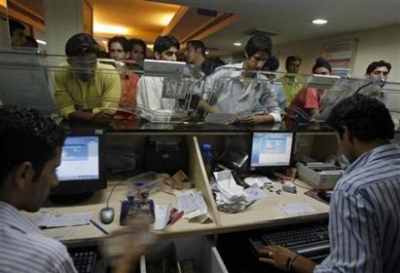
Quarterly results of many of these banks show significant losses.

Public sector banks' cumulative profit crossed the Rs 1 lakh crore-mark in the financial year ended March 2023, with market leader State Bank of India (SBI) accounting for nearly half of the total earnings. From posting a total net loss of Rs 85,390 crore in 2017-18, the Public Sector Banks (PSBs) have come a long way as their profit touched Rs 1,04,649 crore in 2022-23, according to an analysis of their financial results. These 12 PSBs witnessed 57 per cent increase in total profit compared to Rs 66,539.98 crore earned in 2021-22.

Punjab & Sind Bank plans to offer 5% each to top institutions

This is part of the first batch of Supplementary Demands for Grants for 2020-21 moved by Finance Minister Nirmala Sitharaman in the Lok Sabha.

The need to allow government shareholding in public sector banks to come down below 51 per cent

India's public sector banks (PSBs) have seen their net profit nearly treble over the past five years, reaching a record Rs 1.98 trillion in FY26, driven by significant improvements in asset quality and sustained lending growth across key economic sectors.
.jpg)
At the retreat, PSBs had suggested the government cut its stake in these entities to less than 51 per cent over a period of time and empower the boards of individual banks.

Phishing sites mimicked SBI, ICICI Bank and Axis Bank to steal card details and OTPs.
The Economic Offences Wing (EOW) of Odisha Police has arrested another person from Bhubaneswar for his alleged involvement in a bank loan fraud case worth Rs 6.88 crore.
With almost 25,000 seats up for the taking the Common Written Exam for Probationary Officers is a golden opportunity for candidates aspiring for jobs in India's public sector banks.
With almost 25,000 seats up for the taking the Common Written Exam for Probationary Officers is a golden opportunity for candidates aspiring for jobs in India's public sector banks.

Department of financial services secretary Sanjay Malhotra held a meeting with heads of PSBs, insurance companies and financial institutions for identifying ways to support Agniveers on completion of their tenure of duty.

Lack of decisiveness and courage to deal with PSBs may turn out be the biggest impediment to the Modi government's economic initiatives, says Debashis Basu.

Factors like dedicated recovery teams, centralised follow-up on bad loan accounts and resolutions via NCLT are driving the trend

A Bank Investment Company to act as a holding company for state-owned banks would go a long way in minimising government interference and improving governance.
The appointments in 2009-10 would include the CMDs of Syndicate Bank, Bank of India and United Bank of India, sources said. These appointments will be there because of vacancy arising on account of superannuation of the existing chiefs, sources said.
The inefficient public sector with higher costs offers a lobbying cover for the entire sector, which confers even greater benefits on the private sector.

Ironically, bad loans and non-performing assets are on the rise in public sector banks in India, say sector watchers.

The highest number of frauds was reported under the card, Internet, and digital payments categories in FY24 and FY25. 'Advances' accounted for the largest share (85.5 per cent) in FY26.

The government plans to bring down its stake to 26 per cent in these two banks, which are yet to be identified. This may not come in the way of getting investors for these banks, provided the government is willing to step back rather than run them the way it had been doing for over five decades since these banks were nationalised, points out Tamal Bandyopadhyay.

Public resources are scarce and need to be used well.
The banking sector's credibility is on thin ice. Unless the government takes strict steps, things could get worse.

'Banking is the only sector that can see double-digit growth in FY27.'

State Bank of India and IDBI Bank have decided not to go to the IIMs this year.

A sophisticated cross-bank syndicate is systematically defrauding non-resident Indians (NRIs) and elderly citizens by exploiting their fixed deposits through forged documents and fictitious loans, often involving colluding bank employees and real estate deals.

The Bharatiya Janata Party regime will have to make good on this election slogan to restore state-owned banks to health, says Rajiv Lall.
